
Should I Pay Off Debt or Save First?
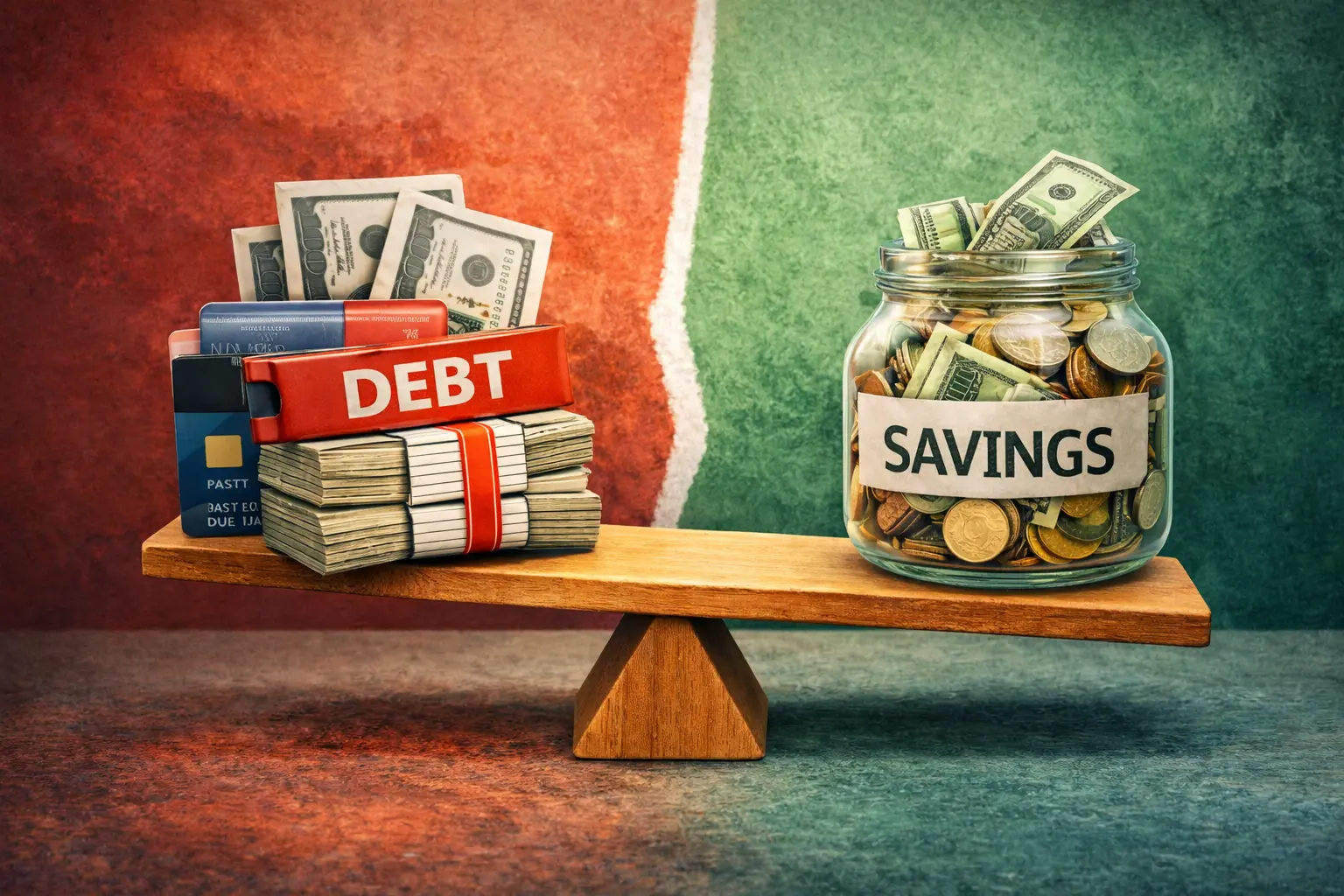
If you have no emergency cushion at all, save a small starter amount first. If you already have a basic cushion and your debt is expensive, paying off high-interest debt usually deserves the next dollar. If both risks are real at the same time, splitting your extra money between savings and debt can be the steadiest move.

On this pageTable of contents
- Quick answer
- Save first when the floor is missing
- Pay debt first when interest is doing the damage
- What counts as expensive debt?
- Split it when both problems are real
- How to decide whether to pay off debt or save first
- What emergency savings really means here
- When low-interest debt can change the answer
- Example scenarios
- What not to do
- Why this question traps so many people
- Use the calculator next
- HonestPocket Take
- FAQ
This question shows up everywhere because it is a real tension, not a cute money debate.
If you save first, you might keep a surprise expense from turning into more debt. If you pay debt first, you may stop interest from quietly chewing on your future. If you try to do everything at once, you may move too slowly to feel anything at all.
So what is the right move?
The most honest answer is this:
Save first if you have no real emergency cushion. Pay high-interest debt first if your basic cushion already exists. Split the difference if both risks are serious at the same time.
That is the useful answer. The internet often tries to turn this into a universal rule. It is not. It depends on your emergency cushion, your interest rates, your income stability, and your real monthly margin.
Quick answer
Here is the practical version:
- No starter cushion? Save a little first.
- Starter cushion already in place and debt is expensive? Pay debt first.
- Income unstable and debt still painful? Split your extra money.
- No extra money at all? You are not at the debt-vs-savings stage yet. Start with monthly margin.
That last one matters more than people think. You cannot optimize money that does not actually exist.
Save first when the floor is missing
If you have zero emergency buffer, one ordinary surprise can send you straight back to the card.
That is why a starter cushion matters. You do not necessarily need a full three to six months before touching debt. But having something between you and chaos matters.
For many people, that means:
- first target: $500 to $1,000 or one important bill
- second target: a larger starter cushion
- longer-term target: several months of core expenses
This is not mathematically perfect. It is strategically sane.
A lot of people get stuck here because they think the choice has to be all or nothing. It does not. You are not trying to become financially invincible before paying debt. You are trying to stop every small emergency from becoming brand-new debt.
That is why even a small emergency fund can matter. The CFPB notes that a starter emergency fund can help you recover from unexpected expenses and get back on track faster. If you have nothing set aside, saving a little first is often less about optimization and more about basic stability.
The same idea shows up in the Federal Reserve’s household well-being data. For many households, a relatively modest unexpected expense can still create real strain. That is exactly why a zero-cushion plan tends to crack so fast.
Pay debt first when interest is doing the damage
Once you have a basic cushion, high-interest debt starts looking like the bigger fire.
Credit card debt in particular tends to make the answer uglier because the rate is often high enough that every extra month costs real money.
If your debt is expensive and your emergency cushion is no longer zero, paying debt first usually makes sense because:
- interest is guaranteed drag
- paying it down improves future cash flow
- it lowers the chance that a balance becomes a long-term roommate
That does not mean draining every dollar of savings to zero. It means the next extra dollar usually leans toward debt once the floor exists.
What counts as expensive debt?
Not all debt deserves the same level of urgency.
A low-rate mortgage is not the same creature as a 25% APR credit card. A manageable federal student loan is not the same as a balance that is chewing up your month with expensive revolving interest.
That is why the interest rate matters so much here. The CFPB explains that a credit card’s APR is the yearly rate you pay for borrowing money. When that rate is high, delay gets expensive fast.
So when this article says “pay debt first,” it is mostly talking about debt that is actively costing you enough to deserve urgency, especially high-interest credit cards and other costly consumer debt.
Split it when both problems are real
This is the part big sites sometimes underplay because “it depends” is less sexy than pretending there is one glorious answer from the heavens.
Sometimes both risks matter at once:
- your savings are thin
- your debt is expensive
- your income is not rock solid
- your margin is positive, but not huge
In that case, splitting may be the best answer.
Example:
- 70% of extra money to debt
- 30% to starter savings
Or:
- enough to keep growing your cushion slowly
- the rest to debt
That approach can reduce interest pressure and reduce the odds that the next emergency becomes new borrowing. It is slower, yes. But sometimes slower is steadier, and steadier wins.
This is also where behavior matters more than spreadsheet purity. A plan only works if you can keep doing it. If an ultra-aggressive debt plan keeps leaving you panicked and underprotected, it may be mathematically tidy but practically weak.
If your margin is tight, automating even a small amount toward savings can help you build the floor while still sending most of the extra money toward debt. CFPB guidance on saving for emergencies also supports automation as a practical way to build savings steadily over time.
How to decide whether to pay off debt or save first
1. Do you have a starter emergency cushion?
If the answer is no, that usually points to saving first, at least briefly.
2. How expensive is the debt?
High-interest debt deserves more urgency than low-rate debt.
3. How stable is your income?
If your income is variable, seasonal, commission-based, or shaky, savings deserves more respect.
4. How much monthly margin do you really have?
This is the upstream question. If you do not know your real margin yet, start there first. The decision calculator works best after you know whether the extra money is actually real.
What emergency savings really means here
When this article says emergency savings, it means cash you could actually use for a real emergency without creating another problem somewhere else.
That usually means money in checking, savings, or another easy-to-reach cash account. It usually does not mean retirement money, borrowed money, or cash that is already assigned to next week’s rent.
That matters because a plan built on money that is not truly available will overstate how safe you are. A thin but real cushion is more useful than a bigger number that disappears once you remember what it was already meant to do.
When low-interest debt can change the answer
This is where nuance matters.
If the debt is relatively low-rate and your savings are weak, the case for building a cushion first gets stronger. Not because low-rate debt is wonderful, but because the urgency may be lower than the risk of having no cash at all.
That does not mean ignore the debt forever. It means the sequence can change depending on the type of debt you have.
For example:
- high-interest credit card debt usually deserves urgency once the floor exists
- lower-rate debt may allow a little more breathing room to build savings first
- mixed debt loads may call for a split approach until the most dangerous balance is under control
This is why blanket advice is so slippery. “Always save first” is too blunt. “Always pay debt first” is too blunt too. The right order depends on what kind of debt is in the room.
Example scenarios
Scenario 1: No savings, credit card debt, unstable month
- savings: $80
- credit card APR: high
- monthly margin: small and inconsistent
Best move: build a starter cushion first, then attack debt harder.
Scenario 2: $1,000 cushion, high-interest card debt, stable job
- starter cushion exists
- debt is expensive
- margin is consistent
Best move: lean harder toward debt payoff.
Scenario 3: Small cushion, expensive debt, nervous income
- both risks matter
- no huge margin
Best move: split your extra money.
Scenario 4: Weak savings, lower-rate debt, steady paycheck
- emergency cushion is too thin
- debt is not the most expensive kind
- income is more stable
Best move: keep building the cushion first or use a lighter split until you are no longer one surprise away from new debt.
What not to do
- Do not wipe savings to absolute zero to chase the “optimal” debt answer.
- Do not ignore high-interest debt forever because saving feels safer.
- Do not assume low-interest debt deserves the same urgency as a 25% APR credit card.
- Do not skip the monthly-margin step if you do not actually know what is left after bills.
Why this question traps so many people
People want one permanent rule because permanent rules feel clean.
Real life is not clean.
A person with no cushion and unstable income is not in the same situation as someone with a starter fund, steady pay, and one ugly credit card balance. The right answer changes when the facts change. That is not inconsistency. That is reality doing reality things.
The best framework is not “always save first” or “always pay debt first.” It is a sequence:
- know your real monthly margin
- protect a basic floor if you have none
- attack expensive debt once the floor exists
- split only when both risks are still active
Use the calculator next
If you want a faster answer based on your numbers, use the Debt or Emergency Fund First Calculator.
It is built to sort between:
- build emergency fund first
- pay debt first
- split focus
And if the tool tells you there is no real room yet, go back one step and use the Monthly Margin Calculator.
HonestPocket Take
People get stuck here because they want one permanent rule.
There is not one.
There is just a better order of operations:
Know your real monthly margin.
Build a basic floor if you have none.
Attack expensive debt once the floor exists.
Split only when both risks are real.
That is not flashy. It is just useful.
FAQ
Should I save $1,000 before paying off debt?
Often, a small starter cushion makes sense before aggressive debt payoff, especially if you have no emergency buffer at all.
What if my debt has a low interest rate?
Low-rate debt may deserve less urgency than high-rate credit card debt, especially if your savings are weak.
Should I use all my extra money for debt?
Not always. If doing that would leave you with no cushion and no stability, it may be too aggressive.
What if I have no extra money?
That usually means you need to start with monthly margin, not debt-vs-savings optimization.
Is splitting my money inefficient?
It can be slower mathematically, but sometimes it is safer behaviorally and practically.
Explore more
Next guides and calculators
Topic hub
Debt & Credit
Get the debt payoff and credit basics that support a steadier reset plan.
Calculator
Debt Payoff Calculator
See how different payoff plans change the timeline and tradeoffs.
Calculator
Debt or Emergency Fund First Calculator
Pressure-test whether extra cash should go to balances or a starter buffer.