
How Much Emergency Fund Do I Need?
Learn how much emergency fund you need based on your job stability, expenses, debt, and household risk—not just a generic rule.

On this pageTable of contents
- Quick answer
- Why the 3-to-6-month rule exists
- When 3 months may be enough
- When you may want 6 months or more
- Why a starter emergency fund still counts
- What should be included in your target
- A better way to choose your target
- Example emergency fund targets
- How to build the fund without stalling everything else
- Where to keep your emergency fund
- When to stop and move on
- Use the calculator next
- HonestPocket Take
- FAQ
The internet loves to answer this question with one sentence:
“Save three to six months of expenses.”
That sentence is useful. It is also incomplete.
Because the real answer is not just about months. It is about risk.
A solid rule of thumb is three to six months of essential expenses, but the right emergency fund depends on how stable your income is, how many people depend on you, how easy your job would be to replace, and whether you are still carrying high-interest debt. If you are just starting, a small starter fund is still worthwhile.
So the honest answer is this:
Three to six months of essential expenses is still the right general range, but your real target depends on how fragile or resilient your situation is.
Quick answer
Use this shortcut:
- Starter phase: save enough to cover a meaningful surprise or one important bill
- Standard target: 3 to 6 months of essential expenses
- Higher-risk target: 6 months or more if your income is unstable or hard to replace
That is the simple version.
The better version is:
- closer to 3 months if your income is stable and your household risk is lower
- closer to 6 months if your income is less predictable or your fixed costs are heavier
- possibly more than 6 months if you are self-employed, the only earner, or in a field where replacing income could take a while
Why the 3-to-6-month rule exists
The point of an emergency fund is not to sit there looking handsome. It is to stop ordinary financial stress from turning into expensive debt or panic decisions.
That is why the target is usually based on essential expenses, not your full lifestyle spending.
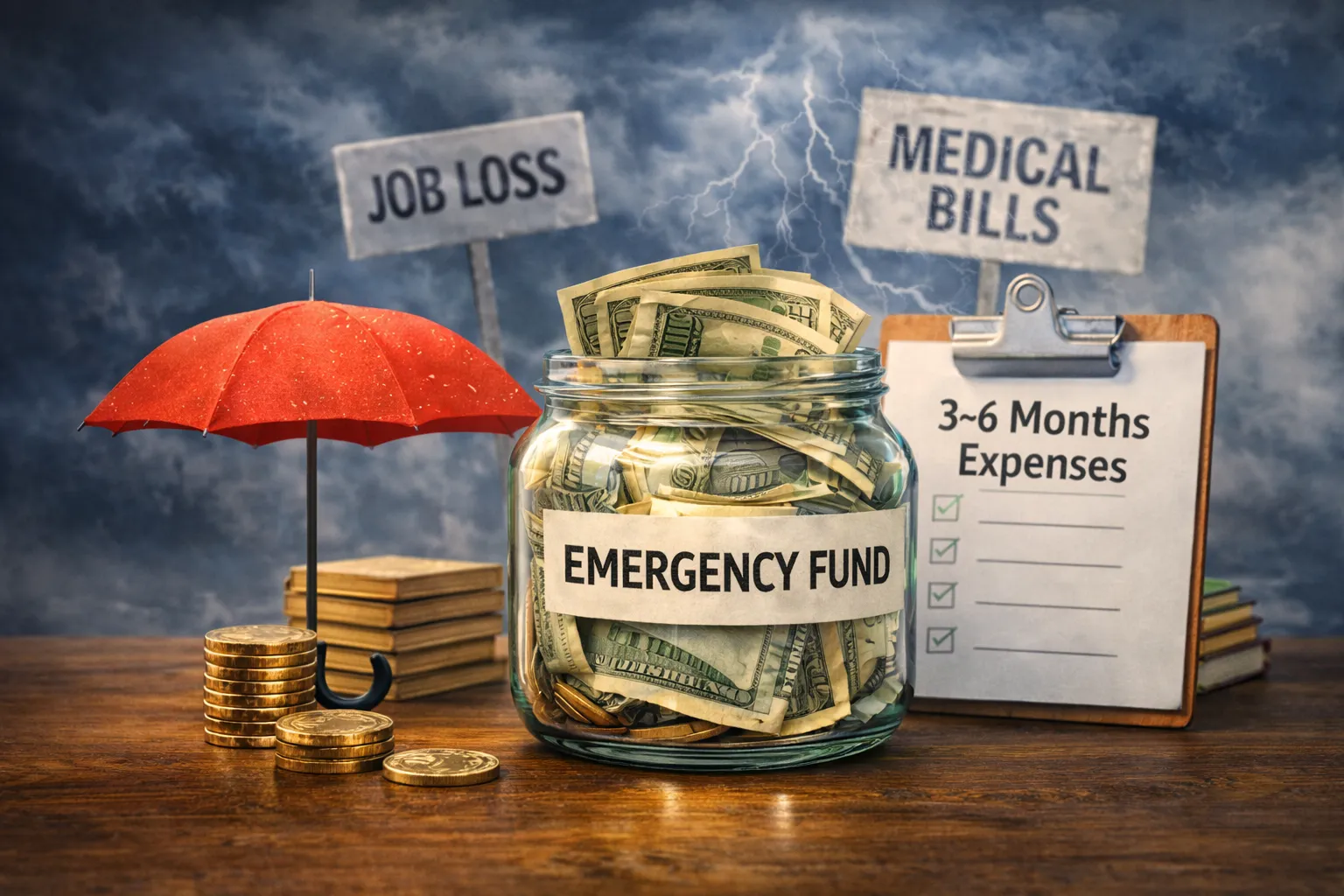
A proper emergency fund is there for things like:
- job loss
- medical bills
- car repairs
- urgent home repairs
- emergency travel
- other true surprises
Not for “I saw a patio set that spoke to me spiritually.”
This is also why a cash cushion matters even before it feels impressive. The Consumer Financial Protection Bureau notes that even a small emergency fund can help you recover faster from unplanned expenses and get back on track.
The Federal Reserve’s household well-being data tells a similar story: relatively small surprise expenses can still be a hardship for many households, which is exactly why this fund exists in the first place.
When 3 months may be enough
Three months can be reasonable if:
- your income is stable
- you have two earners in the household
- your job is relatively easy to replace
- your expenses are flexible
- you do not have many dependents
For a lot of people, 3 months is a practical target because it is big enough to matter but not so huge that it becomes a mythical number you never chase seriously.
A dual-income household with stable salaries and lower fixed costs is usually not dealing with the same level of risk as a one-income household with a mortgage, kids, and variable pay. Same planet. Different weather.
When you may want 6 months or more
Aim toward the higher end if:
- you are self-employed, freelance, or commission-based
- you are the only earner
- you support kids or relatives
- your industry is unstable
- replacing your income would likely take a while
- your monthly obligations are high and inflexible
This is where the generic internet answer usually stops being enough.
A household with stable W-2 income and low fixed costs is not the same beast as a single-income household with variable pay and a mortgage. Same species, very different weather.
Investor.gov notes that many people aim to keep enough savings to cover an emergency, and some keep up to six months of income in savings so it is there when needed. That does not mean everyone needs the same number. It means the higher-risk your situation is, the more the upper end of the range starts to make sense.
Why a starter emergency fund still counts
People sometimes hear “3 to 6 months” and mentally leave the room.
That is understandable. It can sound enormous.
But starting smaller still matters.
A starter emergency fund can:
- keep a car repair off the credit card
- cover a deductible or co-pay
- absorb a bad utility month
- buy you time when something small goes wrong
That is real value.
This is one of the biggest mistakes people make: they treat the full target like it only matters once it is complete. That is not how this works.
The first few hundred dollars matter. The first $1,000 matters. The first month of essentials matters. A partial emergency fund is not worthless just because it is incomplete.
The CFPB’s emergency savings guidance is useful here because it reinforces the boring but important truth: a small starting cushion still improves stability, even before you reach the full long-term target.
What should be included in your target
Essential expenses only
Use the bills that keep life functioning:
- housing
- utilities
- groceries
- transportation
- insurance
- minimum debt payments
- childcare if required
- core medical costs
That is the number to multiply by 3, 4, 5, or 6.
Not every bill belongs in the target
You do not need to fully replicate every nice-to-have category in your emergency fund target.
Streaming subscriptions, dining out, hobby spending, and optional shopping do not all deserve a reserved seat at the emergency table.
The target should protect your basics first.
A good test is this:
If income dropped or life got weird tomorrow, which bills would you still need to pay to keep the lights on and your life operational?
That is your emergency-fund base.
A better way to choose your target
Instead of asking, “What is the right number for everybody?” ask:
1. How stable is my income?
Stable salary? Lower risk.
Variable commissions, self-employment, inconsistent hours, seasonal work? Higher risk.
2. How many people depend on my income?
If other people rely on your paycheck, your margin for error shrinks.
3. How flexible are my monthly expenses?
A household with low fixed costs can adapt more easily than one with a mortgage, car payments, childcare, and insurance premiums stacked like a financial Jenga tower.
4. How fast could I replace my income?
Some jobs are easier to replace than others.
If a layoff would likely turn into a long search, your emergency fund should probably lean larger.
5. Am I also carrying high-interest debt?
If you have zero cushion and expensive credit card debt, the answer may not be “build the full emergency fund first.” It may be “build a basic floor first, then attack the expensive debt.”
That is why this question connects directly to your monthly margin and debt situation.
Example emergency fund targets
Let’s say your essential monthly expenses are $2,800.
That gives you:
- 1 month: $2,800
- 3 months: $8,400
- 6 months: $16,800
Now imagine another household with essential expenses of $4,200 and one variable income.
That gives you:
- 3 months: $12,600
- 6 months: $25,200
Same rule. Very different reality.
Now take it one step further.
Household A has two steady paychecks, no kids, and flexible spending. That household might reasonably decide that 3 months is a solid target.
Household B has one earner, two kids, a mortgage, and commission-based income. That household may sleep a lot better at 6 months or more.
This is why “how much emergency fund do I need?” is really a risk question wearing a math costume.
How to build the fund without stalling everything else
A target is helpful only if the pace is realistic.
If the saving pace is so aggressive that you raid the account every few weeks, the problem is not discipline. The problem is that the plan was built on a number the month cannot actually support yet.
That is why this question connects directly to monthly margin. The right target still needs a realistic path.
A better sequence often looks like this:
- build a starter cushion
- stabilize the budget
- protect against expensive debt spirals
- keep building toward the full target over time
That is less dramatic than “save six months immediately,” but much more useful in real life.
If your monthly room is tight, automate a smaller amount and let consistency do the heavy lifting. CFPB guidance on saving for emergencies and the future also points to automation as one practical way to build savings without relying on daily willpower theatrics.
Where to keep your emergency fund
Your emergency fund should be:
- liquid
- boring
- easy to access
- separate enough that you do not spend it casually
For most people, that means a savings account or money market account that is easy to reach when life gets messy.
This is not the place to chase drama. Emergency money should be available when life gets weird, not when the market feels generous.
The FDIC says a traditional FDIC-insured savings account is a good place to keep money set aside for savings goals because it is easy to access and helps separate the money from everyday spending. FDIC deposit insurance also covers qualifying deposits at insured banks up to at least $250,000 per depositor, per insured bank, for each ownership category.
That is why emergency money usually belongs in a liquid insured account, not in stocks, long-term CDs you cannot easily touch, or some heroic investment scheme cooked up by a guy with a ring light.
When to stop and move on
This part matters.
Your emergency fund target should not become a never-ending side quest that keeps you from every other financial goal.
If you have:
- a reasonable starter cushion
- stable monthly margin
- no immediate crisis
- a clear path to keep building
then you may not need to pause every other goal until the account becomes a monument.
Sometimes the smartest move is:
- build the starter fund
- attack high-interest debt
- then continue building the fund toward your full target
Other times, especially with higher risk, the better move is to keep building cash first.
The point is not to worship one rule. The point is to match the target to your actual life.
Use the calculator next
Use the Emergency Fund Calculator if you want the number fast.
Use the Monthly Margin Calculator first if you are still not sure how much monthly room you actually have to save.
And use Debt or Emergency Fund First Calculator if your next-dollar decision is still a fight between savings and debt payoff.
For broader guidance, keep going with Saving & Cash Management and Start Here.
HonestPocket Take
The most helpful emergency fund target is not the one that sounds most impressive. It is the one that actually matches your risk.
So yes, three to six months is still the right rule of thumb.
But the better question is:
Three to six months of what, for who, and under what level of risk?
That is where your real answer lives.
FAQ
Is $1,000 enough for an emergency fund?
It is a useful starter fund, but it is usually not a full long-term emergency fund for most households.
Should I count minimum debt payments in my emergency fund target?
Yes. If a payment is required to stay current, it belongs in your essential-expense number.
Should my emergency fund include fun spending?
Usually no. Use essential expenses, not full lifestyle spending.
Where should I keep my emergency fund?
Usually in a liquid insured account, not in volatile investments.
What if I have debt too?
That depends on your cushion, interest rate, and monthly margin. Use the debt-vs-emergency-fund calculator for that next step.
Explore more
Next guides and calculators
Topic hub
Saving & Cash Management
Find the saving guides that connect emergency funds to the rest of your cash plan.
Calculator
Emergency Fund Calculator
Estimate a buffer target that fits your bills, income stability, and risk level.
Calculator
Monthly Margin Calculator
Check whether your current budget can support the emergency fund target you want.